
Artemis II Crew Safely Splashes Down in Pacific After Historic Lunar Flyby
By Candid Brief News | CandidBrief.com | April 10, 2026
NASA’s Artemis II mission concluded successfully tonight as the Orion spacecraft carrying four astronauts splashed down safely in the Pacific Ocean off the coast of San Diego, California, at 5:07 p.m. PST (8:07 p.m. EDT). The crew, Commander Reid Wiseman, Pilot Victor Glover, Mission Specialist Christina Koch, and Canadian Space Agency astronaut Jeremy Hansen, are reported in stable condition after the first crewed deep-space return in over five decades.
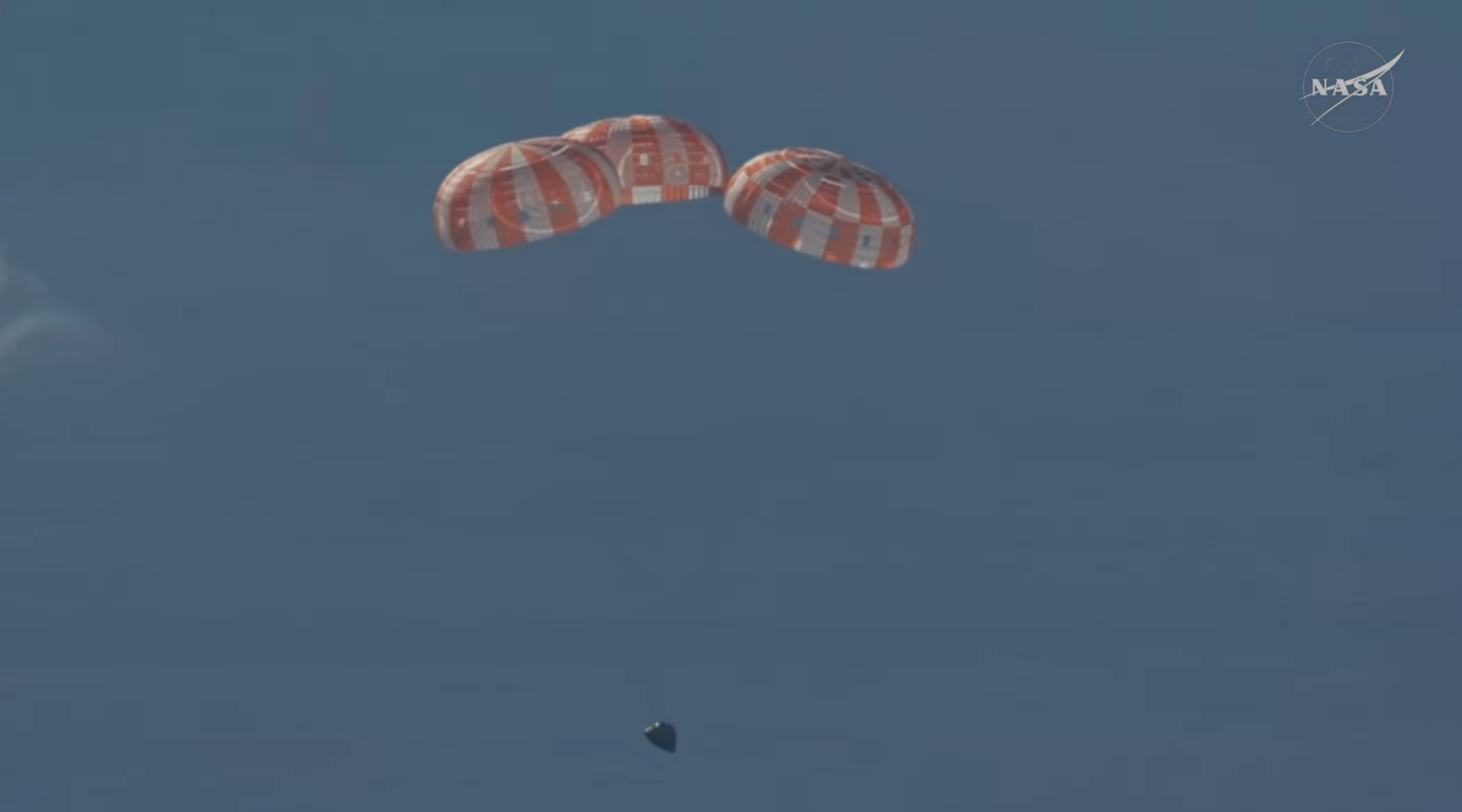
The High-Speed Return and Controlled Descent
Orion slammed into Earth’s atmosphere at approximately 25,000 miles per hour (about 11 km/s), roughly 10 times faster than a speeding bullet, after its record-setting lunar flyby. The spacecraft performed a flawless sequence to shed this enormous velocity safely:
- Final Alignment Burn — A brief engine firing just before atmospheric entry precisely adjusted the capsule’s trajectory.
- Entry Interface — Orion crossed the 400,000-foot atmospheric boundary, where friction began to slow the vehicle dramatically.
- Plasma Blackout Phase — Temperatures on the heat shield reached nearly 5,000°F (2,760°C), ionizing the surrounding air into a glowing plasma sheath that temporarily cut off all radio communication with mission control. During these tense minutes, the crew was completely isolated.
- Aerodynamic Deceleration — The capsule’s blunt-body design and lift-generating shape allowed it to “skip” through the atmosphere, bleeding off speed while keeping peak g-forces to a manageable 4–5g.
- Parachute Deployment Sequence: Drogue Parachutes (deployed at ~22,000 feet): Two small stabilizing chutes first slowed the capsule from supersonic to subsonic speeds and oriented it for the final descent. Main Parachutes (deployed at ~6,000 feet): Three large main parachutes then fully opened, reducing descent speed to a gentle ~17 mph for a safe water landing.
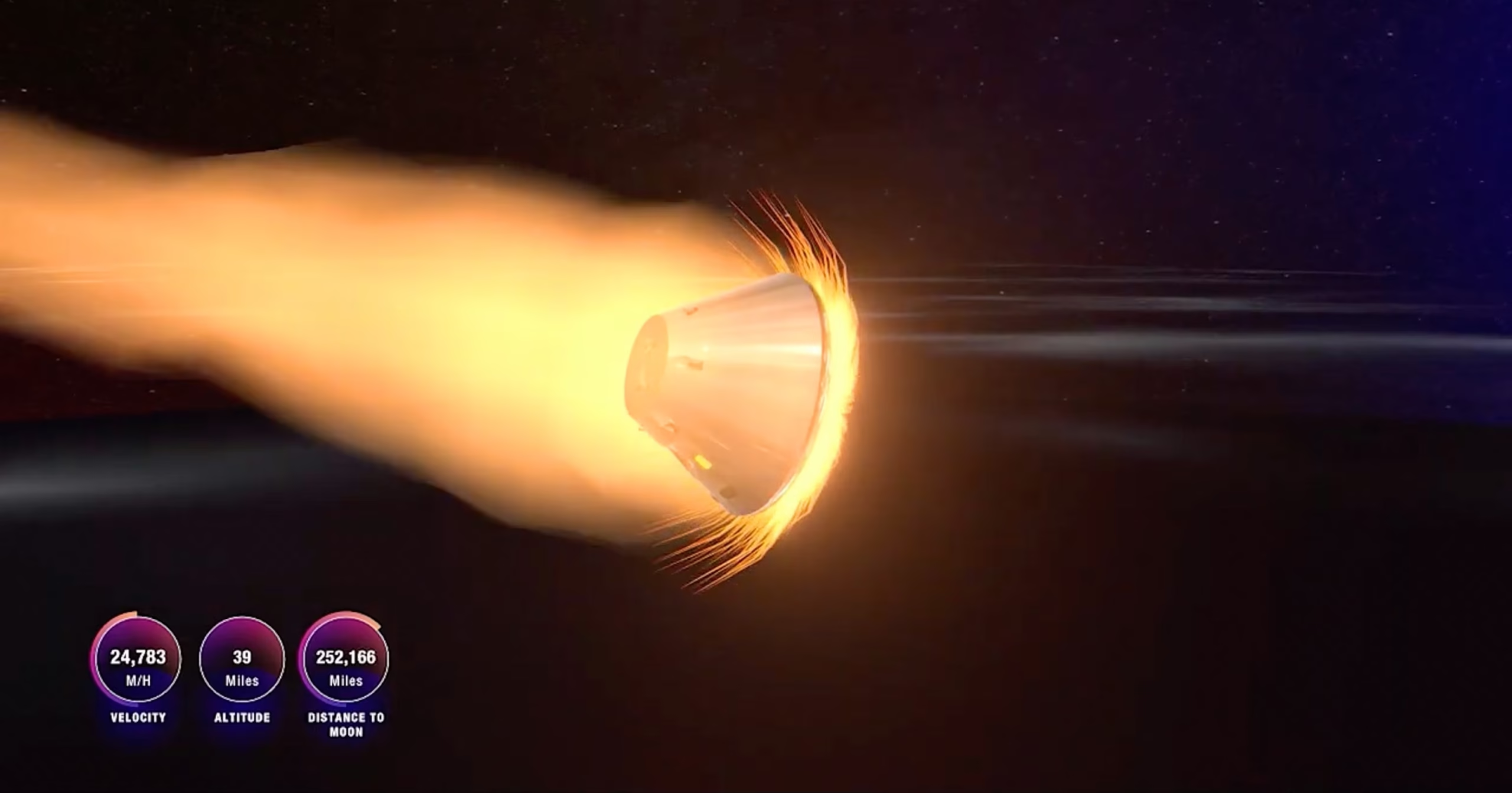
What the Astronauts Experienced
The crew reported feeling intense vibration and heat buildup during the plasma phase, followed by noticeable jolts as the drogue and then main parachutes deployed. Once under full canopy, the ride smoothed out until the firm but survivable impact with the Pacific Ocean. Recovery teams from the U.S. Navy, including the USS John P. Murtha, quickly secured the capsule and assisted the astronauts.
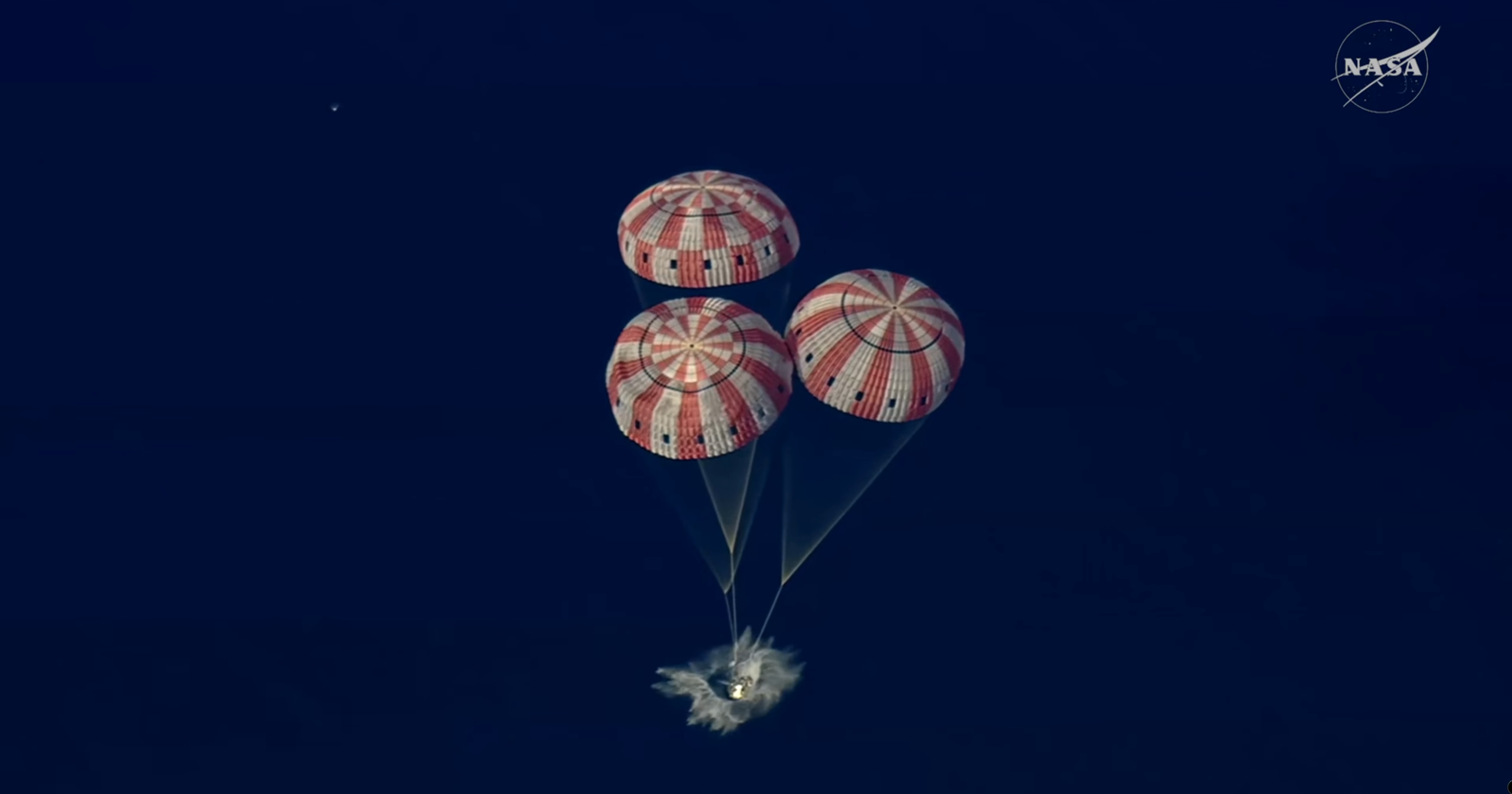
Weather Conditions at the Splash Site
Conditions were favorable for the recovery: modest west-southwest winds, wave heights in the 3–6 foot range, a low (20%) chance of isolated showers, and no significant lightning risk. Visibility remained excellent for the Navy recovery teams.
Why This Matters
The safe return of Artemis II marks a watershed moment in human spaceflight. For the first time since Apollo 17 in 1972, humans have traveled beyond low-Earth orbit, flown around the Moon, and returned safely, proving that NASA’s new deep-space systems (the SLS rocket, Orion spacecraft, and its advanced heat shield and parachute system) are ready for crewed lunar missions.
The mission’s success has immediate and far-reaching impact on humanity. It reignites the spirit of exploration for a new generation, demonstrating that venturing into deep space is once again within our grasp. The data gathered, especially on high-speed re-entry, plasma blackout communications, and long-duration life support, will directly accelerate Artemis III, the first crewed lunar landing since 1972, currently targeted for 2027.
Looking further ahead, Artemis II’s flawless performance is a critical stepping stone toward sustained human presence on the Moon and, eventually, crewed missions to Mars. It validates international partnerships (with Canada, Europe, and Japan) and opens the door for commercial space companies to build on NASA’s proven hardware. For everyday people on Earth, this achievement symbolizes hope, resilience, and the boundless potential of human ingenuity at a time when global challenges often feel overwhelming.
In short, Artemis II was more than a test flight, it was a bridge between the Apollo era and a permanent multi-planetary future for humanity.
Sources (as of April 10, 2026):
- NASA official mission updates and live recovery coverage
- Reporting from Florida Today, Scientific American, AccuWeather, and local San Diego weather sources
Disclaimer: This article is a curated news roundup and analysis compiled by the Candid Brief News editorial team based on reporting from multiple established and trusted sources. Candid Brief News adds value through careful story selection, neutral summaries, contextual analysis, and occasional original commentary. We do not claim to have independent on-the-ground reporting for every story. Readers are encouraged to visit the original sources linked in each article for full details and the latest updates. All credit for original reporting belongs to the respective journalists and news organizations.