
Trump Announces Iran Has Fully Reopened the Strait of Hormuz
By Candid Brief News | CandidBrief.com | April 16, 2026
President Donald J. Trump posted on Truth Social early this morning declaring that Iran has fully reopened the Strait of Hormuz to international shipping. The announcement marks a significant breakthrough after weeks of U.S. naval pressure and failed negotiations.
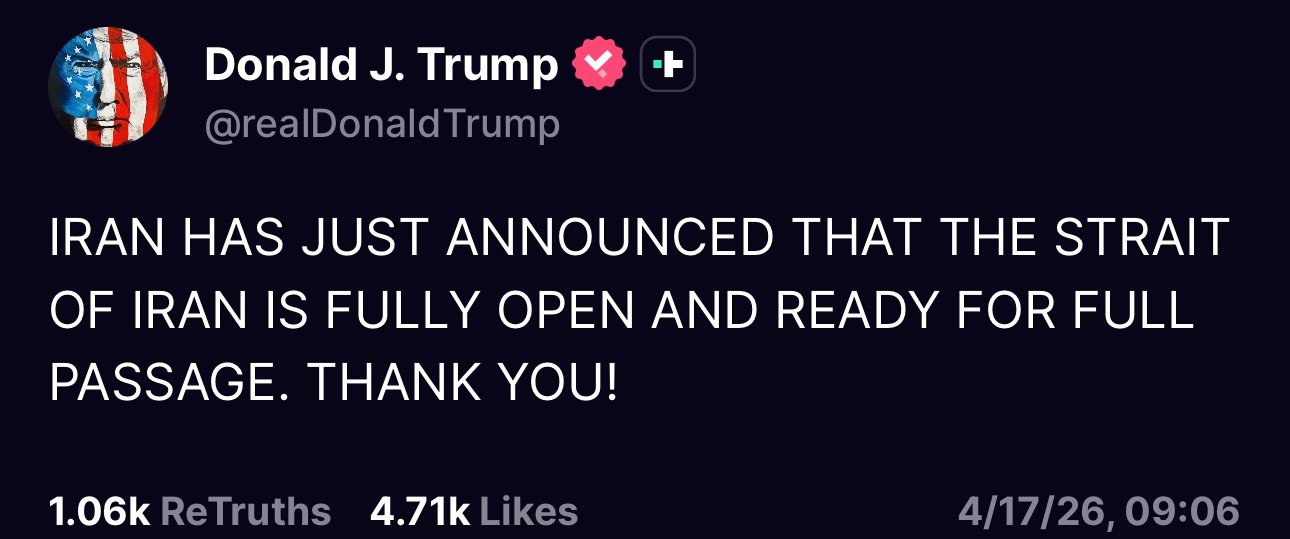
Trump’s Announcement
In the post, Trump stated that Iran has agreed to allow unrestricted passage through the critical waterway, ending the effective blockade that had disrupted roughly 20% of global oil and significant liquefied natural gas shipments. He described the development as a direct result of sustained U.S. pressure and credited the recent naval posture for forcing Tehran’s hand.
Impact on the Global Economy
The full reopening of the Strait of Hormuz is expected to have immediate and far-reaching positive effects. The waterway is the world’s most important energy chokepoint. With shipping lanes now clear, oil and LNG tankers can resume normal operations without the threat of mines, tolls, or interdiction. This should quickly restore supply chain stability and reduce the enormous economic uncertainty that has weighed on markets since the conflict began.
Fuel Prices and Jet Fuel Prices
Crude oil futures are already reacting sharply. Analysts expect Brent crude to drop $8–15 per barrel in the coming days as the risk premium evaporates. Gasoline prices at the pump in the United States could fall 20–40 cents per gallon within two to three weeks, providing relief to American drivers and businesses.
Jet fuel prices, which have more than doubled in recent weeks and forced major airlines (United, Delta, and low-cost carriers) to slash schedules are also set for rapid relief. Industry experts predict jet fuel costs could decline 25–35% in the short term, potentially allowing carriers to restore canceled flights, reduce fare surcharges, and stabilize summer travel plans.
Positive Consequences Leading to a Complete Peace Deal
The reopening removes the single biggest immediate obstacle in U.S.-Iran negotiations. With the Strait of Hormuz no longer a flashpoint, both sides now have breathing room to address the core issue: Iran’s nuclear program.
Trump’s announcement signals that the administration views this as a genuine turning point. It creates momentum for the broader 15-point framework discussed in earlier talks, including phased sanctions relief, verification of uranium stockpiles, and long-term security guarantees. Analysts say a successful Hormuz reopening dramatically raises the odds of a comprehensive peace deal within the next 30–60 days, potentially ending the five-week conflict and preventing further escalation.
Why This Matters
This is one of the most significant de-escalation moments in the current Middle East crisis. For the global economy, it means lower energy costs, reduced inflation pressure, and restored confidence in supply chains. For American consumers and businesses, it translates directly into cheaper fuel at the pump and more affordable air travel.
For the Trump administration, the breakthrough validates its maximum-pressure strategy and opens a genuine path to a wider regional peace. If the momentum holds, it could lead to the first comprehensive U.S.-Iran agreement in decades, stabilize oil markets for the foreseeable future, and allow the U.S. to reduce its military footprint in the Gulf.
The coming days will be critical. Markets will watch closely for confirmation that tankers are once again moving freely, while diplomats on both sides work to turn this tactical victory into a lasting strategic deal.
Sources (as of April 16, 2026):
- President Trump’s Truth Social posts (April 16, 2026)
- White House and Pentagon statements
- Reporting from Reuters, Bloomberg, Argus Media, and The Wall Street Journal
Disclaimer: This article is a curated news roundup and analysis compiled by the Candid Brief News editorial team based on reporting from multiple established and trusted sources. Candid Brief News adds value through careful story selection, neutral summaries, contextual analysis, and occasional original commentary. We do not claim to have independent on-the-ground reporting for every story. Readers are encouraged to visit the original sources linked in each article for full details and the latest updates. All credit for original reporting belongs to the respective journalists and news organizations.